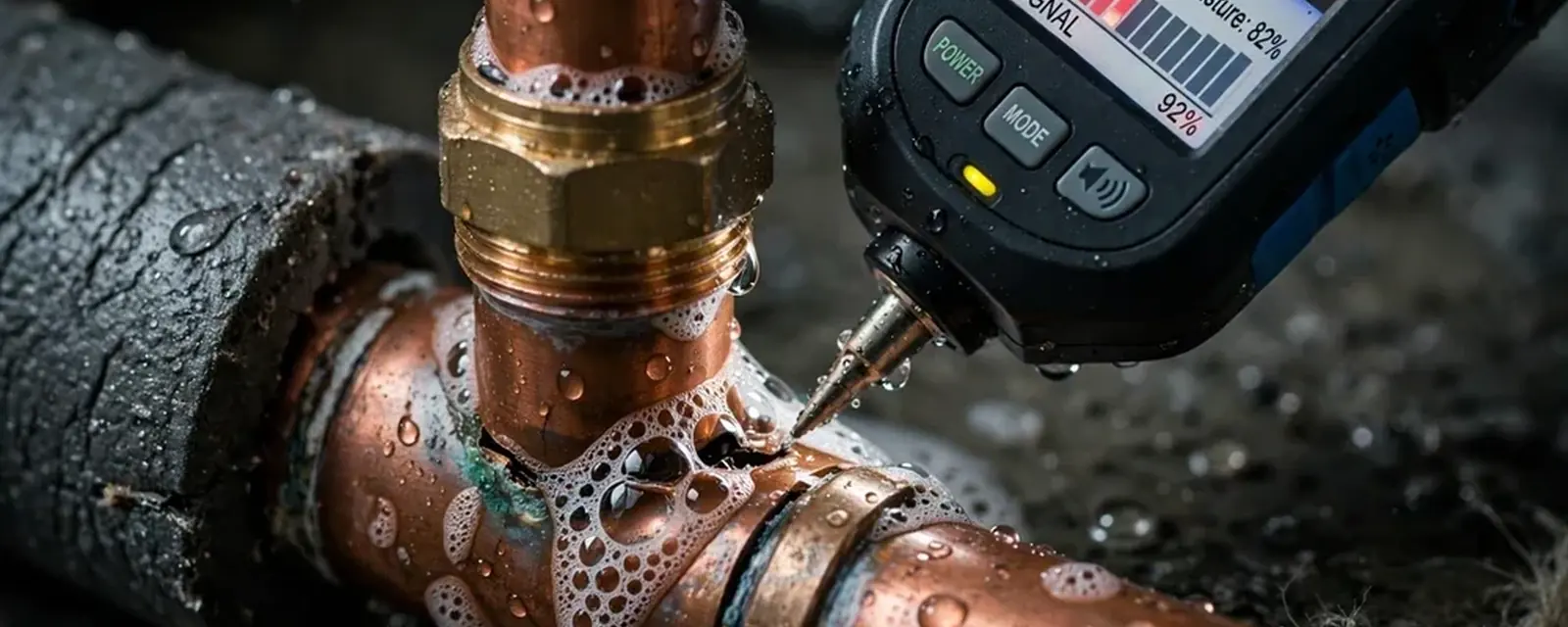
When a hidden leak is an emergency
Treat these as urgent: water stains spreading across a ceiling, a wall that feels warm or wet, the sound of running water when every fixture is off, or a meter that keeps moving after you close the main. We take after-hours calls for all of them.
If water is coming through a ceiling, place a bucket and keep clear of any light fixture near the stain. A wet ceiling can hold more weight than it looks.
How we find a leak without opening the house
Check the meter
With all water off, a moving meter confirms a leak and tells us it is on the pressurized supply side.
Isolate the line
We close valves in sections and watch the pressure to learn which part of the system is losing water.
Listen and scan
Acoustic listening gear hears the hiss at the leak. Thermal imaging and moisture meters show where heat or damp is spreading.
Confirm and quote
We mark the spot, explain the repair and give you a clear price before work starts.
Reading your water meter on Mercer Island
The City of Mercer Island buys its water from Seattle Public Utilities and reads about 7,800 water meters. The City says it cannot control the plumbing inside your home, so finding a leak in your own pipes falls to you and your plumber.
A quick test helps. Turn off every fixture, then watch the meter dial or low-flow indicator for a few minutes. If it moves, water is leaking somewhere. A jump on your bill with no change in habits is a reason to call, and Public Works at (206) 275-7608 can answer billing questions on their side.
Repairs we make after locating a leak follow the Uniform Plumbing Code (UPC) with Washington amendments.
Source type: City of Mercer Island water utility and Public Works pages| Symptom | Likely source | Where we look |
|---|---|---|
| Meter moves with everything off | Supply line or fixture | Valves, water heater, meter box, service line |
| Warm spot on a floor | Hot line in slab | Slab leak (listening and thermal) |
| Stain on a ceiling | Upper-floor supply or drain | Bathroom above, attic lines |
| Soggy yard near the meter | Service line or irrigation | Yard and meter box |
Slab leaks, service lines and crawlspaces
A slab leak is a supply pipe that has failed under a concrete floor. Signs include a warm floor, a hissing sound and a rise in the water bill. If your house sits on a slab, check for those signs.
In a house with a crawlspace, a leak can sit unseen for weeks. We check under-house lines, and we look at the service line that runs from the meter to the house. Water that surfaces in the yard or around the meter box points to a buried supply leak.
Pool, spa and irrigation lines get the same treatment. A sprinkler line that leaks can run up a bill quietly, and we isolate each zone to find it.
Homeowner policies often cover a sudden leak and the damage it causes but not the pipe that wore out, so ask before you file. You get a clear price before work starts. Call (206) 864-6558 to describe what you are seeing.
Think you have a hidden leak?
Call the 24/7 line and a plumber will help you narrow it down.
Commercial leak detection
Businesses lose water quietly through restroom fixtures and underground supply. Our commercial plumbing team handles leak checks on a schedule that avoids closing the shop.
If a leak has already broken a pipe, see burst pipe repair. For a corroded run that keeps leaking, repiping may be the better route.
Leak Detection questions from Mercer Island homeowners
Yes. The 24/7 line is open. We also work in Medina. Shut off the main valve if water is escaping.
Turn off all water, then watch the meter. A moving dial or flashing low-flow indicator means water is passing, which means a leak. Check that the toilets are not running first.
Usually yes. Listening, thermal imaging and pressure tests narrow the leak to a small area, and we open only that spot.
If our tests point to the line near the meter or the meter itself, call Public Works at (206) 275-7608 so the City can tell you who owns that section. We tell you if the results lead that way.
Some policies cover finding a leak that caused covered damage. Ask your carrier before the visit and keep the report we give you.