Safety first
If you smell gas, leave the building and call Puget Sound Energy at 1-888-225-5773 or 911 from outside. Do not use switches, a landline or any flame. PSE responds to reports at no charge.
Never try to splice or extend a gas line yourself. A small leak can become a fire or an explosion, and the cost of a mistake is far higher than the cost of a licensed install.
How a gas line is planned
- List every gas appliance and its BTU rating
- Measure the pipe run from the meter or the main line
- Choose a pipe material allowed for the use
- Size the pipe so each appliance gets enough gas at full load
- Plan shutoff valves and sediment traps where required
Pipe size depends on total load and length. A tankless water heater adds a big load, and a range or a fireplace adds more. An undersized line starves appliances.
Have a plumbing problem now?
Call the 24/7 line and a plumber will talk it through.
| Appliance | Typical need | Notes |
|---|---|---|
| Gas range | Moderate load | Needs a shutoff and a flexible connector |
| Dryer | Moderate load | Needs a shutoff and venting |
| Tankless water heater | High load | May need a larger line, see tankless |
| Fireplace or fire pit | Varies | Needs a shutoff and correct valve type |
Plan and permit
We size the line and file the permit where required.
Install the pipe
Pipe is run, supported and fitted with shutoffs.
Pressure test
The line is tested before it is covered or connected.
Inspect and connect
After the inspection, appliances are connected and leak-checked.
Materials and connections, in brief
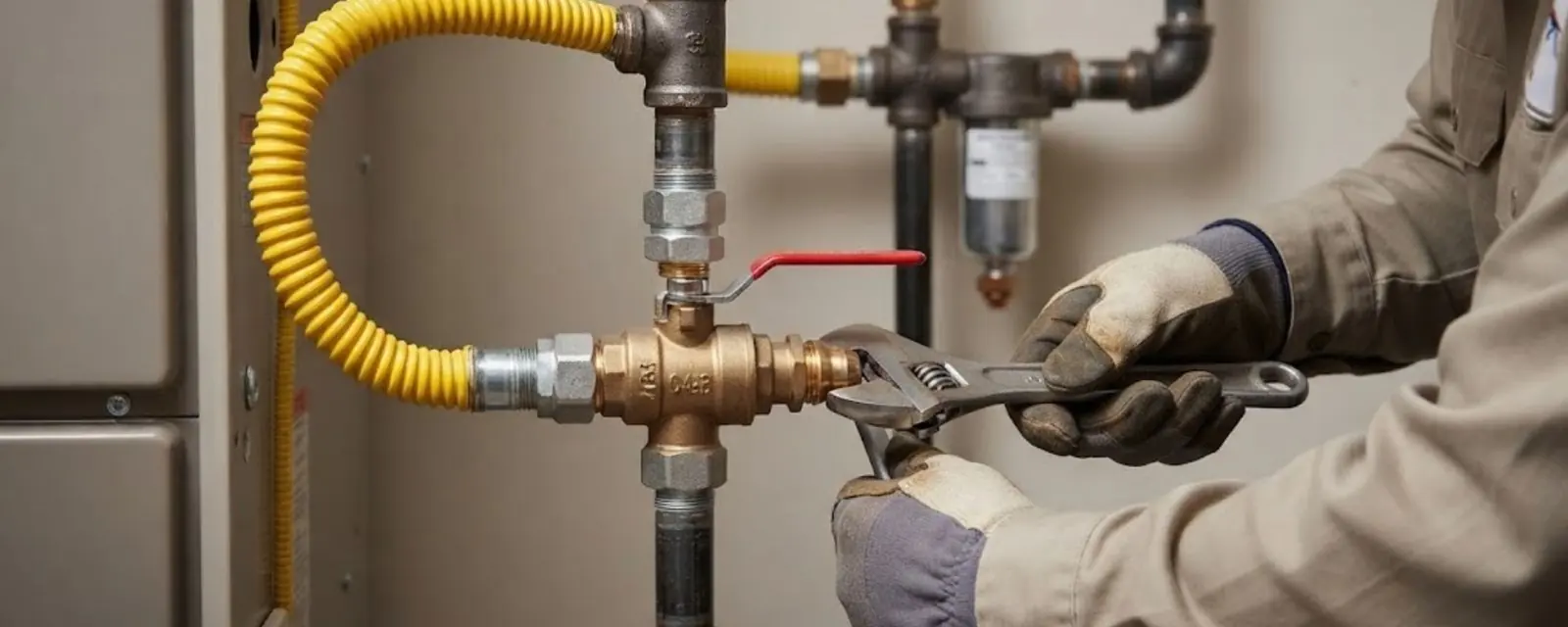
Gas piping can be black iron, coated corrugated stainless steel tubing or another approved material, depending on the use and the rules in force. Joints are made with the proper fittings and sealed with a gas-rated compound or tape. Appliances connect with approved flexible connectors and a shutoff valve within reach.
Your plumber chooses the material for your job and follows the permit and inspection steps. A pressure test proves the system holds before gas flows, and a leak check at each connection confirms it after.
What it costs and what changes the price
The cost depends on the distance from the meter, the number of appliances, the pipe material, the access through walls and floors and the permit fees. A short run to a range in an open kitchen is a small job. A long run to a pool heater or a generator is larger.
Ask for a written price before work starts. A good quote lists the pipe size, the length, the permit and the test. If the meter has to be upgraded, ask PSE about that separately.
Questions to ask before you hire
Ask who will pull the permit and who will be on site for the inspection. Ask what pressure test is planned and how long the line holds pressure before it is covered. Ask which shutoff valves will be added, and where, so you can find them in an emergency.
A plumber who answers these plainly, and who puts the scope and the price in writing, is one you can trust with a gas line. Vague answers about permits are a reason to keep looking.
Permits and the gas utility on Mercer Island
The MyBuildingPermit chart, which covers Mercer Island, lists gas piping as permit work. The Permit Counter at (206) 275-7605 can explain the steps, and most single-family plumbing permits can be handled online at mybuildingpermit.com.
Puget Sound Energy is the gas utility. If you are adding a large appliance, ask PSE who owns and maintains the meter and service line and whether the meter supports the load. Before any digging near a line, call 811 so underground utilities can be marked.
Washington plumbing follows the Uniform Plumbing Code (UPC) with state amendments, and the Permit Counter can say which code governs each part of a gas job.
Source type: MyBuildingPermit permits chart, City of Mercer Island permit pages and Puget Sound EnergyWorking with a plumber
Ask for the load calculation and the pipe sizing in writing. A good plumber explains the route, the materials and the test. Our plumbing installation service covers gas piping alongside water and drain work, and a gas water heater installation uses the same planning.
Be ready to shut off the gas at the appliance if you ever have a doubt. Install a carbon monoxide alarm near sleeping areas and gas appliances.
Signs of a gas problem after install
- A rotten egg smell
- A hissing sound near a pipe or valve
- Dead plants near a buried line
- A pilot that will not stay lit
- Soot or discoloration near an appliance
Gas plumbing questions
The MyBuildingPermit chart lists gas piping as permit work. Confirm with the Permit Counter at (206) 275-7605.
Puget Sound Energy is the gas utility. Call PSE at 1-888-225-5773 and ask who owns and maintains the meter and service line, and whether it supports a larger load.
Leave the building and call PSE at 1-888-225-5773 or 911. Do not go back in until you are told it is safe.
We serve Medina and Mercer Island. Permit offices differ by city.